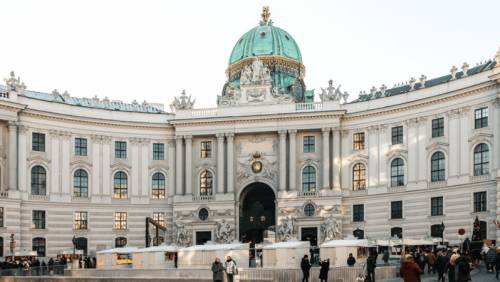
The Habsburg dynasty is one of the most important and long-lasting royal houses in Europe, having ruled over vast territories for centuries.
The Habsburg family traces its origins to the eponymous castle located in Switzerland, built around 1020. The name "Habsburg" derives from the Habsburg Castle. During the 12th and 13th centuries, the family expanded territorially and politically.
In 1273, Rudolf I of Habsburg was elected King of the Romans, becoming the first member of the dynasty to attain an imperial position. He conquered Bohemia and consolidated the family's power.
Frederick III (1415-1493) was the first emperor of the family to rule the Holy Roman Empire from 1452. He established Vienna as the capital of the Habsburgs and consolidated the dynasty's power.
Maximilian I (1459-1519), Frederick's grandson, significantly expanded the Habsburg territories through strategic marriages. He married Mary of Burgundy, acquiring vast territories in the Netherlands and Burgundy.
One of the most famous Habsburgs was Charles V (1500-1558), who ruled over an immense empire that included Spain, the Netherlands, Italy, Austria, the American colonies, and the Holy Roman Empire. During his reign, the empire was the largest in Europe since the time of Charlemagne.
After the abdication of Charles V, the empire was divided into two main branches: the Spanish branch, led by Philip II, and the Austrian branch, led by Ferdinand I.
The Spanish branch ruled over Spain, Naples, Sicily, and the American colonies, while the Austrian branch maintained control over the Holy Roman Empire territories and other European regions.
During the 17th century, the Habsburgs faced numerous challenges, including the devastating Thirty Years' War (1618-1648), which significantly weakened the Holy Roman Empire. Despite this, they managed to maintain control over Austria and other surrounding territories.
Maria Theresa (1717-1780) was one of the most important figures of the Habsburgs, ruling over a multi-ethnic empire and initiating significant administrative and military reforms. Her marriage to Francis Stephen of Lorraine further consolidated the dynasty's power.
Her son, Joseph II, continued the Enlightenment reforms, modernizing the empire.
The Habsburgs continued to rule until the dissolution of the Holy Roman Empire in 1806, after the Napoleonic Wars. Subsequently, they ruled as Emperors of Austria.
After the defeat in World War I and the dissolution of the Austro-Hungarian Empire in 1918, the last emperor, Charles I, abdicated, marking the end of Habsburg rule.
1 hour of use
Unlock Artificial Intelligence (AI) and enhance your experience
Do you want to explore even more or discover cities not yet covered by the app?
Activate our AI.
It will guide you with the same engaging tone, answering your curiosities in real-time.