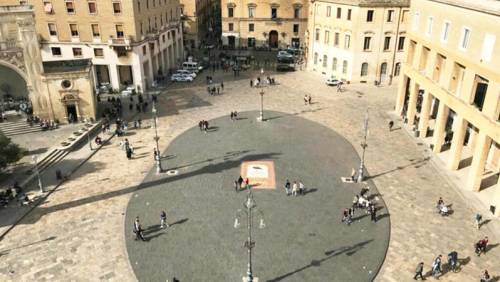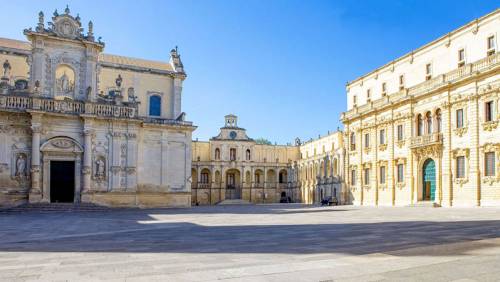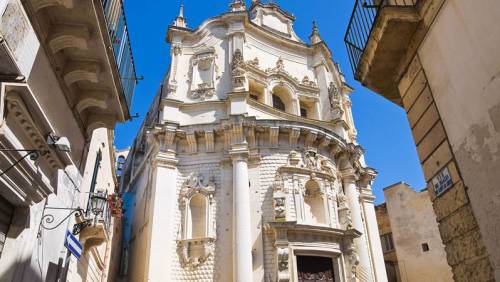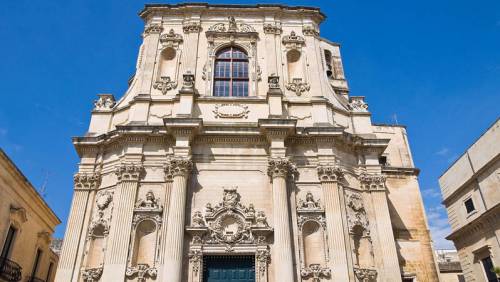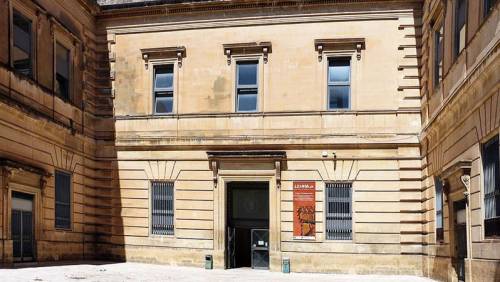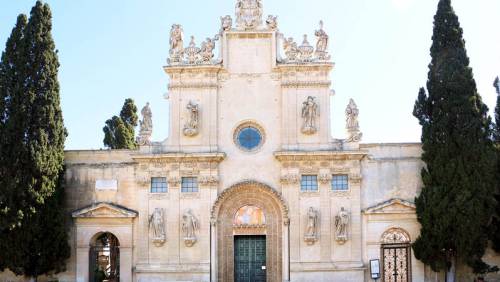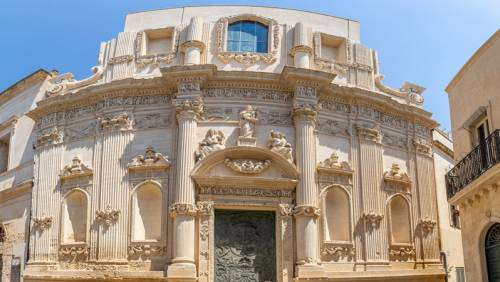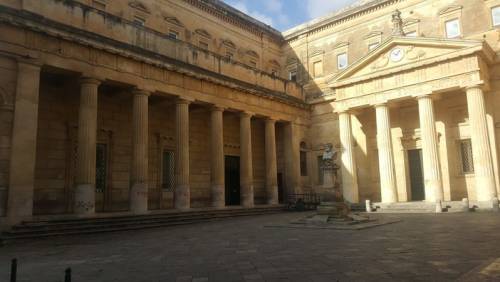
As you can see, the Church of San Francesco della Scarpa — literally “St. Francis of the Shoe” — is one of the most unusual churches in Lecce. It stands out from the others for a surprising detail: it doesn’t have a façade.
Originally, of course, the façade did exist, but at the end of the 19th century it was demolished to make space for the large portico of the former Palmieri Boarding School, the neoclassical building you can see in front of you. With the construction of the colonnade, the church’s entrance was hidden and the nave shortened, giving it the distinctive appearance it still has today.
According to tradition, St. Francis of Assisi, on his return from the Holy Land in 1219, stopped nearby to pray. That’s why, a few years later, the Franciscan friars built a church and a convent right here, on land donated by the noble Guarini family, Dukes of Poggiardo.
In the following centuries, San Francesco della Scarpa became one of Lecce’s main spiritual centers and the burial place of its most illustrious families. Among the most important funerary monuments is that of the great preacher Friar Roberto Caracciolo, which is still preserved today in the Chapel of St. Louis.
Between 1699 and 1714, the church was rebuilt in Baroque style, with new chapels, a large transept, and a deep presbytery. The ceiling decorations were commissioned from the painter Tommaso De Leo, who gave the interior an elegant and harmonious atmosphere.
The 19th century, however, changed everything: when the religious orders were suppressed, the friars were forced to abandon the convent, and many sacred furnishings were dismantled and moved elsewhere.
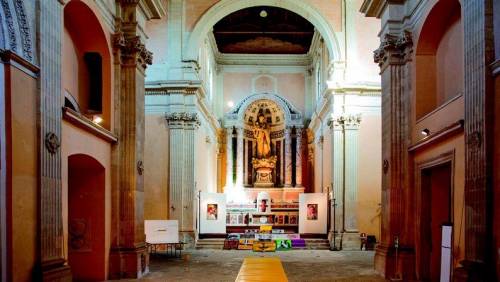
Today, as you enter, you’ll find yourself in a bright space with a Greek-cross layout. The walls are divided by pilasters and decorative moldings that draw the eye upward. The light filtering through the windows enhances the golden tones of the Lecce stone, creating an atmosphere of peace and contemplation.
In the transept, you can admire two magnificent altars: the Altar of the Immaculate Conception, carved in 1599 by Francesco Antonio Zimbalo, and the Altar of St. Francis of Assisi, which recalls the church’s origins.
But the true showstopper awaits you in the presbytery: here stands a giant papier-mâché statue of St. Joseph holding the Child Jesus, modeled in 1833 by Oronzo Greco. Almost six meters tall, it’s considered the largest papier-mâché statue in the world.
Next to the church, there’s a small oratory linked to the tradition that St. Francis himself prayed there during his brief stay in Lecce.
Although the church is deconsecrated today, it continues to live on as a venue for exhibitions, concerts, and cultural events — a place where art, history, and spirituality intertwine, still reflecting Lecce’s deep Franciscan soul.
Here’s an interesting fact: The name “della Scarpa” — meaning “of the shoe” — refers to the Conventual Franciscans, known as “the ones with shoes,” distinguishing them from the Observant Franciscans, who traditionally went barefoot.
1 hour of use
Unlock Artificial Intelligence (AI) and enhance your experience
Do you want to explore even more or discover cities not yet covered by the app?
Activate our AI.
It will guide you with the same engaging tone, answering your curiosities in real-time.