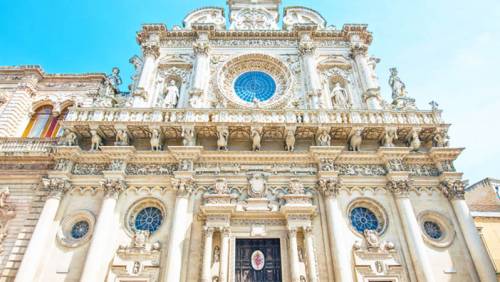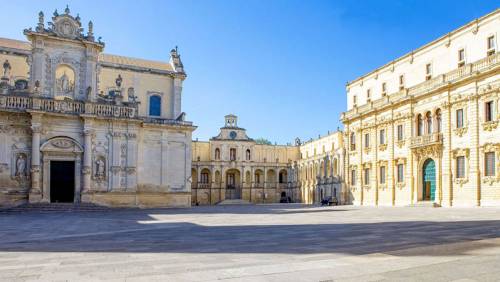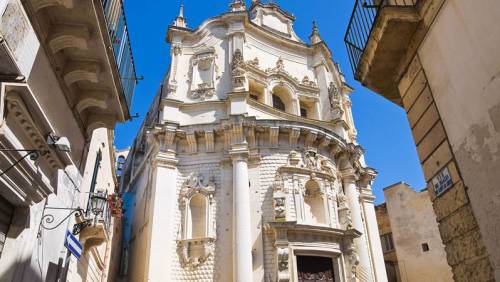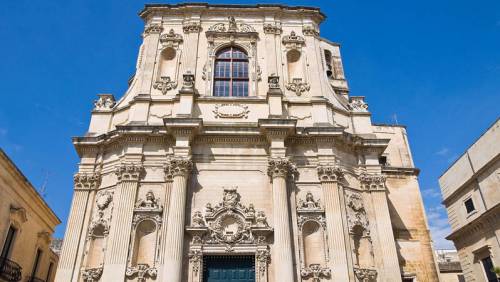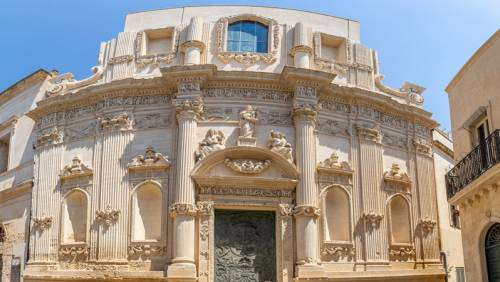
The Church of Sant’Angelo — dedicated to St. Michael the Archangel, whose name means “Saint Angel” — is one of the oldest sacred buildings in the city, dating back to 1061. Originally, the church was dedicated to the Virgin Mary of Constantinople, but in the 14th century it was renovated and rededicated to St. Michael, hence the popular name Sant’Angelo.
After major reconstruction work that began in 1663, the church became a splendid example of Lecce Baroque and was consecrated again under the double title of Sant’Angelo and Santa Maria di Costantinopoli.
Its façade is striking for both its Baroque richness and its unfinished structure: the upper section was never completed due to lack of funds and ends abruptly on either side of a large central window.
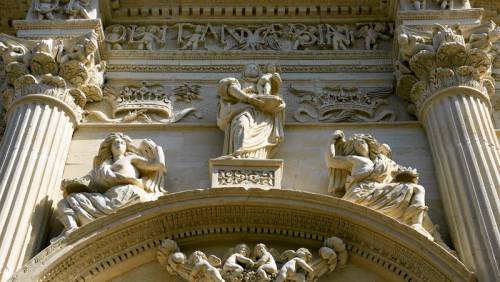
The main portal, topped by a lunette depicting the Madonna and Child with two angels, is flanked by carved cherubs, eagles, and lions holding a Latin inscription dedicated to the Mother of God of Constantinople and dated 1663.
A particularly fine feature is the wood and bronze door, cast in 1750 from a design by Emanuele Manieri. The panels display a double-headed eagle, symbol of the Augustinian monks, while the portal itself is framed by Baroque decorations in Lecce stone, attributed to the school of Giuseppe Zimbalo.
Now please pause the audio and resume once you’re inside.
As you can see, the church has a Latin cross layout with a single, bright nave leading to a deep rectangular choir.
The side walls are divided by pillars topped with unique capitals, each richly decorated with figurative and floral motifs. These open onto the side chapels, each containing a Baroque altar in Lecce stone, embellished with twisted columns, garlands, and statues.
In the transept, two altars stand out: on the right, the Altar of Our Lady of Sorrows, featuring a magnificent papier-mâché statue of the Virgin by Antonio Maccagnani, made in 1832; on the left, the Altar of St. Anthony the Abbot, with a large 18th-century canvas by Alessandro Calabrese.
The raised presbytery houses the main altar, dedicated to the Madonna of Constantinople, crowned by a 17th-century altarpiece depicting the Virgin and Child surrounded by saints.
Completing the ensemble are several 17th- and 18th-century paintings, which enrich the interior with scenes from the Bible and venerated saints.
Here’s an interesting fact: According to legend, the sculptor Antonio Maccagnani, commissioned in 1832 to create the statue of the Sorrowful Virgin, struggled to capture the pain in Mary’s expression. One night, after returning home slightly drunk, he saw his mother waiting for him at the door with a sad, worried face. It was from that very expression that he found the inspiration to complete his statue.
1 hour of use
Unlock Artificial Intelligence (AI) and enhance your experience
Do you want to explore even more or discover cities not yet covered by the app?
Activate our AI.
It will guide you with the same engaging tone, answering your curiosities in real-time.