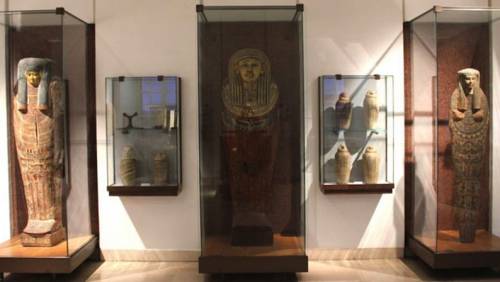
The Egyptian Collection is displayed in the basement, spread across seven rooms, from XVII to XXIII. The first two introductory rooms are dedicated to the history of the collection and the fascination with Egyptian antiquities, while the following rooms are organized thematically—covering topics such as power, the world of the dead, religion and magic, and social and economic organization.
The collection preserved at the Archaeological Museum of Naples is one of the oldest Egyptian collections in Europe, with around 2,500 artifacts spanning over three millennia of history.
The exhibition comes to life in Room XIX, where you’ll find works that portray the face of power—such as the famous “Lady of Naples” from the Old Kingdom, the statue of the butler Nakt from the Middle Kingdom, and the Monument of Amenemone from the New Kingdom. This section is particularly valuable for understanding the evolution of royal and administrative iconography across Egypt’s major historical periods.
The funerary theme is explored in Room XX, where you can admire stelae such as those of Hat and Amenhotep, painted reliefs, a rich series of ushabti—the small servant figurines placed in the tombs of the elite—along with jewelry, ornaments, and other objects from burial assemblages. Here you’ll also find the precious Book of the Dead of Khonsu.
In Room XXI, the focus is on mummification, featuring human mummies, sarcophagi, amulets, scarab-shaped seals, and canopic jars.
Room XXII highlights Egyptian religion and syncretism—the blending of native and foreign religious elements. On display are stone and bronze statuettes, temple artifacts, and even three mummified crocodiles dedicated to the god Sobek, illustrating the diversity of local cults and the sacred role of animals as divine protectors.
The final section, Room XXIII, is devoted to language and hieroglyphs, the work of scribes and sculptors, and the cultural and commercial connections between Egypt and the Mediterranean world from the 8th century BC through the Roman era.
Here’s an interesting fact: Don’t be misled by the statue known as the “Lady of Naples.” In reality, this sculpture—dating from the Old Kingdom—actually depicts a man, a high-ranking official. The misleading nickname originated in the 18th century, when the statue was discovered and mistakenly identified as a female portrait. The name stuck, and it continues to appear today in the museum’s catalogues and displays.
1 hour of use
Unlock Artificial Intelligence (AI) and enhance your experience
Do you want to explore even more or discover cities not yet covered by the app?
Activate our AI.
It will guide you with the same engaging tone, answering your curiosities in real-time.