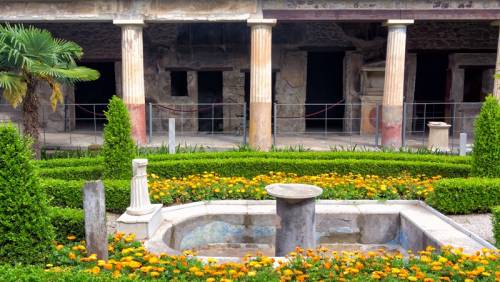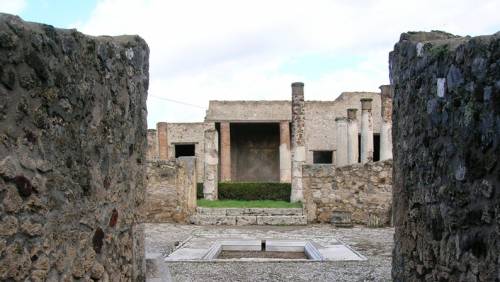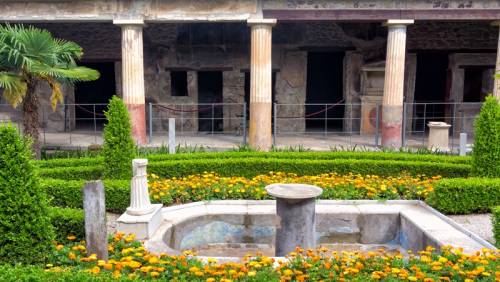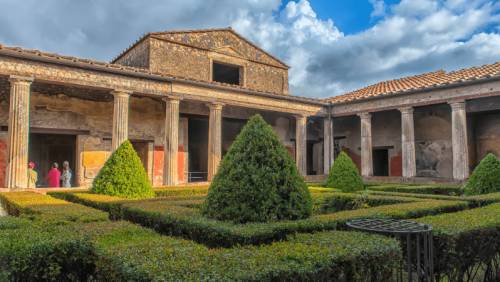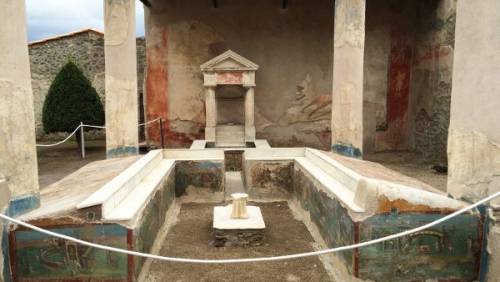
At the heart of the House of the Golden Cupids lies a Rhodian-style peristyle—an inner garden surrounded by columns on all four sides, with the northern portico taller than the others and topped by a small triangular pediment.
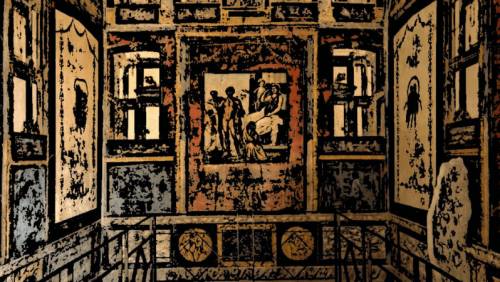
From this courtyard opened the main reception hall, a grand space used to welcome distinguished guests. It was adorned with refined mythological paintings and a mosaic floor featuring a central rosette motif.
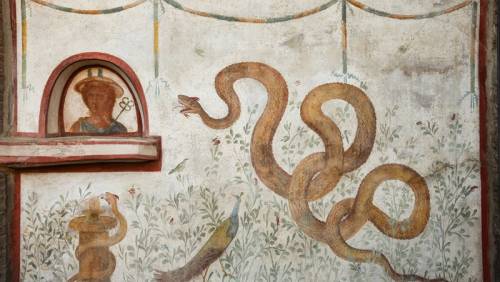
The peristyle, however, was more than just a decorative courtyard—it was also a sacred space. On one side stood a lararium, the small shrine devoted to the Lares, the household gods protecting the family and the home. On the other side was a sanctuary in the Egyptian style, with images associated with the cult of the goddess Isis. Among them were Isis, Serapis, Harpocrates, and Anubis, recognizable by his jackal’s head. The presence of these deities reveals how Egyptian religion had become deeply rooted in Pompeii by the 1st century A.D.
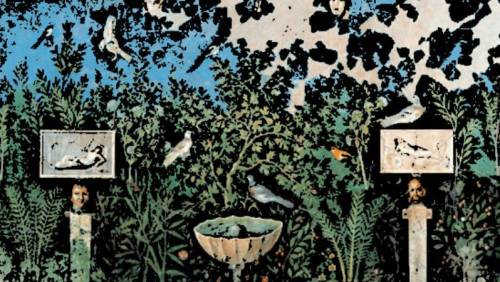
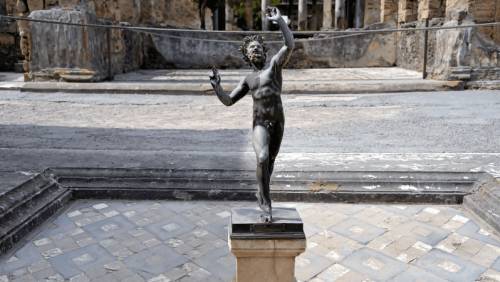
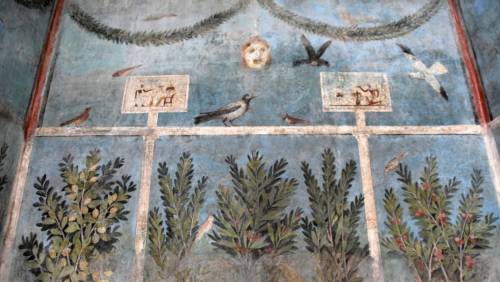
The garden also served as a private art gallery, displaying reliefs and sculptures, some of which were authentic Greek originals.
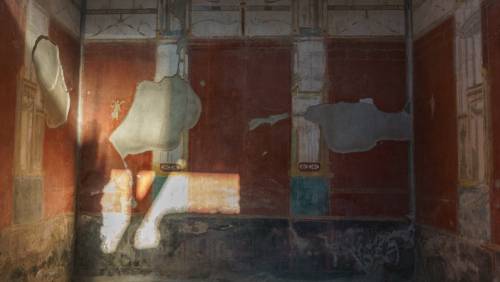
The house owes its name to a small room along the portico where the walls were decorated with glass medallions engraved with cupids and covered with thin sheets of gold. These golden cupids gave the chamber its precious and distinctive appearance. Sadly, many of them were lost, particularly after the 1943 bombings, which damaged part of the building.
Archaeologists believe the residence belonged to Gnaeus Poppaeus Habitus, possibly related to Poppaea Sabina, the wife of Emperor Nero. This theory is supported by the discovery of graffiti bearing his name and a signet ring found on the premises.
From an architectural standpoint, the House of the Golden Cupids perfectly illustrates the evolution of the Roman domus: the entrance atrium, with its rainwater basin, loses its central role, while the peristyle becomes the true hub of domestic and social life. It was here that the most lavish decorations were concentrated, and where guests were led to admire the splendor of paintings, statues, and gardens.
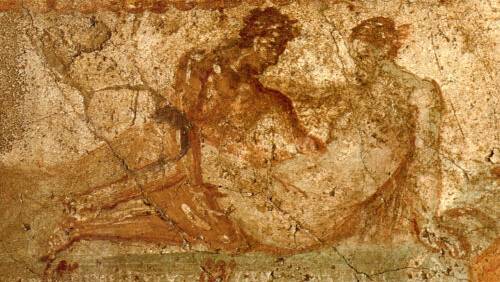
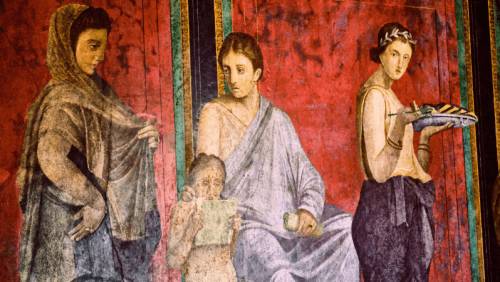
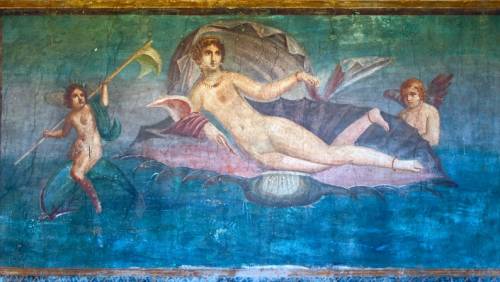
Let me leave you with an interesting fact: cupids, often portrayed as small winged putti, symbolized love, playfulness, and vitality. In Pompeii, they frequently appear in frescoes and mosaics of the wealthiest homes, evoking both the grace of Greco-Roman mythology and a wish for joy and prosperity for the family who lived there.
1 hour of use
Unlock Artificial Intelligence (AI) and enhance your experience
Do you want to explore even more or discover cities not yet covered by the app?
Activate our AI.
It will guide you with the same engaging tone, answering your curiosities in real-time.