Presentation - Ai Voice STABIANA STREET

Original audio guides written by expert authors
and voiced by professional speakers.
2:50

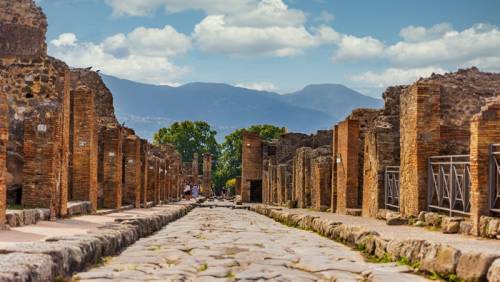
Among the streets of Pompeii, Via Stabiana stands out because it cuts through the city from north to south, connecting several neighborhoods and intersecting the two main east–west routes: Via dell’Abbondanza and Via di Nola.
Its modern name comes from the road that once led out of Pompeii toward the nearby town of Stabiae; the original ancient name, however, has not been preserved.

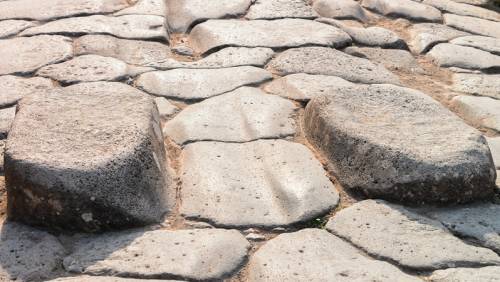
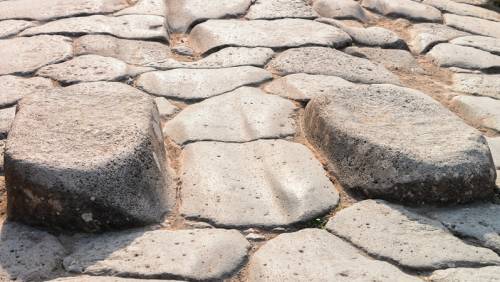
The blocks along Via Stabiana reveal the most practical side of everyday life. Workshops, small artisan spaces, and food stalls once animated this busy street. The slope of the paving stones was designed to channel away rainwater, while deep cart ruts and raised stepping stones reflect the constant flow of traffic. Public fountains at the intersections supplied water to both residents and travelers, making this street a true lifeline of the ancient city.

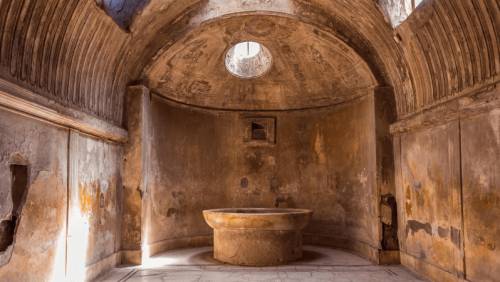
The most evocative stretch of Via Stabiana is the one devoted to the culture of well-being. Here stood two major bath complexes: the Stabian Baths — among the oldest in Pompeii, complete with a gymnasium and separate sections for men and women — and, farther north, the Central Baths, begun after the earthquake of A.D. 62 but never fully completed. These establishments were not only places for cleanliness; they were social and recreational hubs where people met, negotiated business, and strengthened personal connections.

Another striking feature of the street is the abundance of graffiti and electoral inscriptions that once covered its façades. Short messages, campaign slogans, and notices of daily life transformed Via Stabiana into an open-air bulletin board, revealing how the community used public space for communication and expression.

As you walk along the street, notice how its atmosphere changes: it moves from the more commercial and artisan areas to the district of the major public baths, and then toward the crossroads leading to Pompeii’s more elegant residential quarters.


Let me leave you with an interesting fact: along Via Stabiana, archaeologists have discovered numerous electoral programmata — painted slogans encouraging citizens to vote for specific candidates. Many were signed by neighborhood groups or craft guilds. One inscription reads: “The bakers support Lucius Popidius Sabinus for aedile.”
It’s direct evidence that this street was not only a commercial artery but also a political arena where tradespeople made their voices heard.


TravelMate recommends

CHOOSE THE OPTION
THAT SUITS YOU BEST just like more than 500.000 users have already done

Buy Pompeii 69 min, 28 stories

Permanently unlock the app with all content of Pompeii for
€ 8,99
Buy
Promotion 4776 min, 1579 stories
Unlock audio content of all available cities for 3 years at the promotional price

Included cities Amalfi Coast, Amsterdam, Assisi, Athens, Barcelona, Beijing, Bergamo, Berlin, Cinque Terre, Como, Dubai, Florence, Hong Kong , Lecce, London, Madrid, Miami, Milan, Moscow, Naples, New York, Palermo, Paris, Pisa, Pompeii, Prague, Ravenna, Rome, Saint Petersburg, Santorini, Singapore, Tokyo, Trento, Turin, Venice, Verona , Vienna, Washington
€ 19,99
Buy
TravelMate AI 60  

1 hour of use

Unlock Artificial Intelligence (AI) and enhance your experience
Do you want to explore even more or discover cities not yet covered by the app?
Activate our AI.
It will guide you with the same engaging tone, answering your curiosities in real-time.

€ 4,99
Buy
Don't miss out!
POMPEI INTRODUCTION
4 Audio

POMPEI INTRODUCTION

Thanks to the initiatives of the Bourbon family, when Goethe visited they had already been carrying out systematic excavations for about 30 years on the cities that had been buried by the eruption of...
STREET OF ABUNDANCE
1 Audio

STREET OF ABUNDANCE

Since Roman times, this thoroughfare has been a lively center of commerce, craftsmanship, and social life. Today, it offers scholars one of the best places to study the daily rhythms of the city...
STABIANA STREET
1 Audio

STABIANA STREET

The blocks along Via Stabiana reveal the most practical side of everyday life. Workshops, small artisan spaces, and food stalls once animated this busy street. The slope of the paving stones was...
THERMAE-REGIO VII
1 Audio

THERMAE-REGIO VII

In Pompeii, even today, in Regio VI you can see the Castellum Aquae, a structure built at the highest point of the city, inside which was a basin for collecting water from the aqueduct, from which it...
TEMPLE OF APOLLO-REGIO VII
1 Audio

TEMPLE OF APOLLO-REGIO VII

It was during the archaeological excavations that artifacts such as vases and votive objects, dating back as far as the sixth century BC, were discovered. These objects are currently kept in the...
FORUM-REGIO VII
1 Audio

FORUM-REGIO VII

Around the square, try to imagine a large portico with Doric columns, and a complex of public buildings such as the administrative offices, the 'Comitium' where elections were held, and the 'Basilica'...
LUPANARE-REGIO VII
1 Audio

LUPANARE-REGIO VII

It is necessary to make this clarification because this activity, which was legal and considered useful for society, did not only take place in the lupanare. Just imagine, at most businesses where...
HOUSE OF TRITTOLEMO-REGIO VII
1 Audio

HOUSE OF TRITTOLEMO-REGIO VII

At the heart of the house was the triclinium, the dining room used for banquets, decorated with a truly remarkable fresco. It depicts Triptolemus, the young hero of Greek mythology, receiving from...
HOUSES OF MARCUS RUFUS AND THE GOLDEN BRACELET-REGIO VII
1 Audio

HOUSES OF MARCUS RUFUS AND THE GOLDEN BRACELET-REGIO VII

Here, the domus were built right next to the walls, even incorporating them, and projecting their extension outside the walls, with splendid rooms and gardens laid out in terraces sloping down towards...
GRAND THEATRE-REGIO VIII
1 Audio

GRAND THEATRE-REGIO VIII

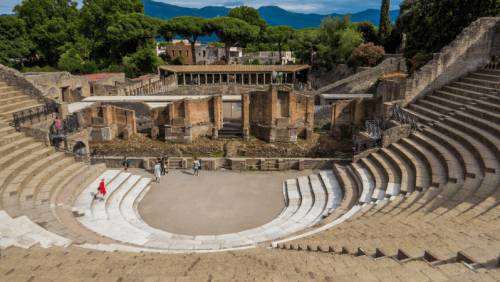
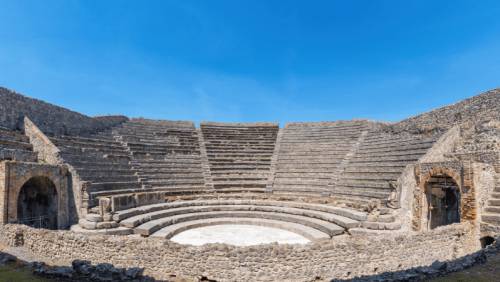
For this reason, a large semi-circular structure was built in Pompeii as early as the second century BC, now identified as the Grand Theatre, which was enlarged and modified over the following...
IMPERIAL VILLA-REGIO VIII
2 Audio

IMPERIAL VILLA-REGIO VIII

Construction began in the final decade of the 1st century B.C., during the Augustan age, likely as an elegant private residence belonging to a wealthy and influential family. The villa occupied a...
HOUSE OF THE TRAGIC POET-REGIO VI
1 Audio

HOUSE OF THE TRAGIC POET-REGIO VI

This work, in fact, depicts actors preparing to stage a tragedy. The genre of the performance can be guessed from the type of masks placed on the floor near the actors. What you are about to visit is...
HOUSE OF THE FAUN-REGIO VI
1 Audio

HOUSE OF THE FAUN-REGIO VI

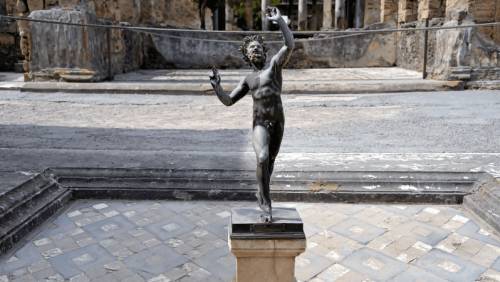
On the pavement in front of the entrance you are greeted by a welcome sign in Latin, 'HAVE', and as soon as you enter you see, in the center of the impluvium of the main atrium, a copy of the famous...
HOUSE OF VETTII-REGIO VI
1 Audio

HOUSE OF VETTII-REGIO VI

The two former slaves, who became wealthy landowners, were mainly involved in trading agricultural products and wine. In order to create this large mansion, they had joined two pre-existing ones and...
HOUSE OF THE GILDED CUPIDS-REGIO VI
1 Audio

HOUSE OF THE GILDED CUPIDS-REGIO VI

From this courtyard opened the main reception hall, a grand space used to welcome distinguished guests. It was adorned with refined mythological paintings and a mosaic floor featuring a central...
VILLA OF THE MYSTERIES- REGIO VI SUBURBIO
1 Audio

VILLA OF THE MYSTERIES- REGIO VI SUBURBIO

It is a large, square-plan villa that had a different organization from classical Roman mansions. At the entrance, there was an area for the production and trade of wine and rooms such as kitchens...
HOUSE OF MENANDER-REGIO I
1 Audio

HOUSE OF MENANDER-REGIO I

Scholars believe that its owner, Quintus Poppaeus Sabinus, was related to Emperor Nero's second wife, Poppaea Sabina, and that he also owned the domus in Pompeii now known as the House of the Golden...
HOUSE OF THE CRYPTOPORTICUS-REGIO I
1 Audio

HOUSE OF THE CRYPTOPORTICUS-REGIO I

The domus was originally built as an independent residence between the late 2nd and 1st centuries B.C. Later, the garden level was raised, and the ground-floor porticoes were transformed into the...
STEPHANUS’ FULLONICA-REGIO I
1 Audio

STEPHANUS’ FULLONICA-REGIO I

This fullonica was built during the final phase of Pompeii’s urban development. The structure was originally a domus with an atrium at its entrance. It was later converted into a laundry...
HOUSE OF THE ORCHARD-REGIO I
1 Audio

HOUSE OF THE ORCHARD-REGIO I

These wall paintings depict lush gardens, filled with trees, flowers, and ornamental plants. Unlike in most Roman houses of the time, where garden scenes typically adorned reception areas, here they...
HOUSE OF THE EPHIBE-REGIO I
1 Audio

HOUSE OF THE EPHIBE-REGIO I

This residence was among the largest in Pompeii, covering about 1,200 square meters. It was created by merging three adjoining houses, purchased at different times, and likely belonged to Publius...
AMPHITHEATRE-REGIO II
1 Audio

AMPHITHEATRE-REGIO II

Elliptical in shape, with a length of 135 meters and a width of 104 meters, it could accommodate up to 20,000 spectators, protected from sun and weather by an imposing roof, the velarium. Precisely...
HOUSE OF VENUS IN THE SHELL-REGIO II
2 Audio

HOUSE OF VENUS IN THE SHELL-REGIO II

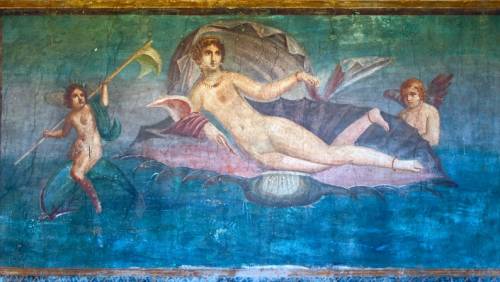
Découverte au cours des fouilles menées entre 1933 et 1953, la maison appartenait très probablement à la puissante famille des Satrii, influente dans les dernières...
TravelMate App

DOWNLOAD NOW
THE TRAVELMATE APP

Purchase your activation code, download the TravelMate App, and turn your smartphone into your personal travel companion!
Listen to audio guides about the wonders of the world with TravelMate.
HAVE FUN!