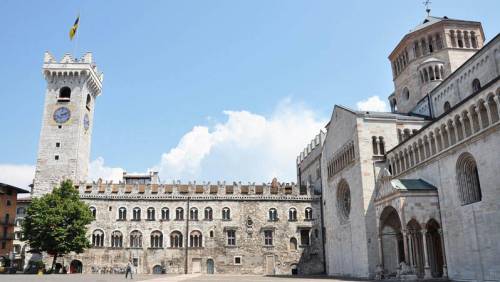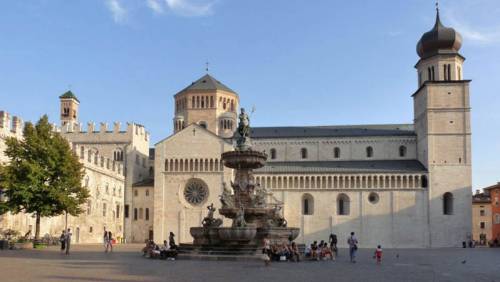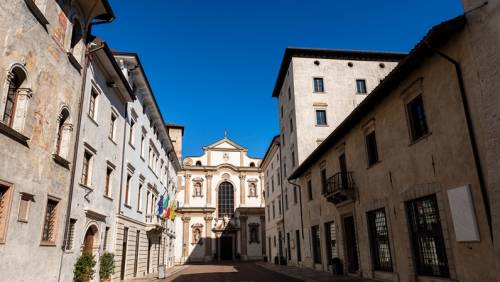
Palazzo Roccabruna is one of the finest Renaissance residences in the city.
Its story is closely tied to Canon Gerolamo II Roccabruna, a member of one of Trento’s most distinguished families in the 16th century. Between 1557 and 1559, Gerolamo purchased and unified several houses in the Borgo Nuovo district to create an elegant noble residence, which was completed in 1562.
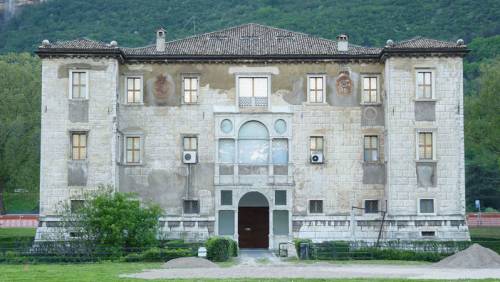
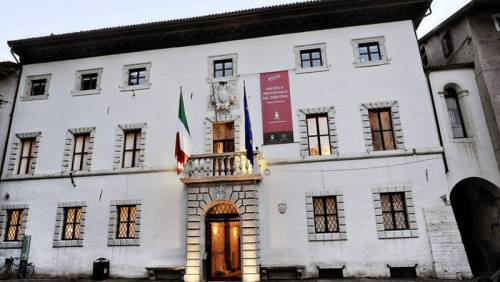
The main façade reflects the building’s representative function. The rusticated portal, featuring the Roccabruna family crest on the keystone and two stone benches on either side, is topped by a balcony bearing another coat of arms in stucco—probably linked to the Madruzzo noble family.
Another distinctive emblem decorates the façade: a radiant sun with a human face, a flower, and the Latin motto Nec Sorte Movebor — “I shall not be moved by fate.” Known as the ‘Roccabruna Bell’, this emblem symbolized the family’s strength and pride.
Passing through the portal, visitors enter an atrium adorned with stuccoed vaults and busts of Roman emperors, setting a tone of grandeur.
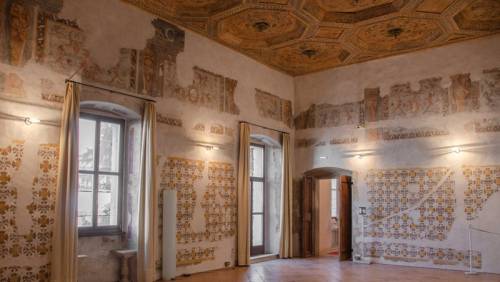
The most impressive room is the “Sala del Conte di Luna” (Hall of the Count of Luna) on the main floor, where you can still admire encaustic frescoes — a technique that mixes pigments with wax fixed by heat to achieve luminous, long-lasting colors. The hall is named after Claudio Fernandez de Quiñones, the Count of Luna and Spanish ambassador, who stayed in the palace in 1563 during the Council of Trent.
Another fascinating feature is the Chapel of Saint Jerome, which extends like a bridge over Vicolo Gaudenti, linking Palazzo Roccabruna to an adjacent building. Its walls are decorated with fourteen scenes from the life of the saint, and it once housed a portrait of Canon Roccabruna, long attributed to Titian.
After centuries of changes in ownership, the Trento Chamber of Commerce purchased and restored the building in 2002. Today it hosts cultural and gastronomic events, and since 2007, it has been home to the Trentino Provincial Wine Cellar (Enoteca Provinciale del Trentino), where visitors can taste fine local wines and explore a historic collection of labels that tell the story of the region’s winemaking tradition.
Let me leave you with an interesting fact: among the treasures preserved in the Enoteca’s historic collection is the renowned Vino Santo Trentino, produced through a unique winemaking process. The grapes are dried for several months on racks, concentrating their sugars before pressing. The result is a sweet, amber-colored wine, best enjoyed slowly to savor its complex and nuanced flavors.
1 hour of use
Unlock Artificial Intelligence (AI) and enhance your experience
Do you want to explore even more or discover cities not yet covered by the app?
Activate our AI.
It will guide you with the same engaging tone, answering your curiosities in real-time.