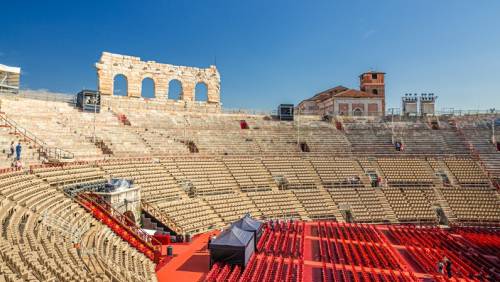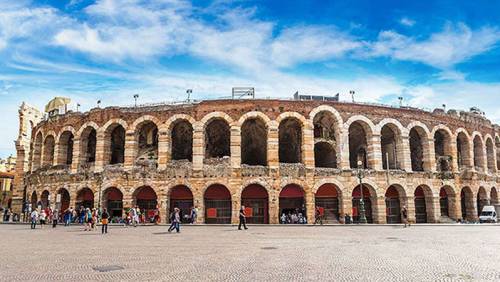
The interior of the Verona Arena appears as a majestic stone oval, remarkably well preserved despite its two thousand years of history and continuous use. The cavea, or tiered seating area, was originally designed to hold about 30,000 spectators, and even today its concentric rings of stone, rising toward the sky, create a breathtaking sense of space and grandeur.
At the center lies the arena floor itself, a vast elliptical space that, in Roman times, hosted gladiatorial combats, animal hunts, and other public spectacles.
Access to the seating was provided through the vomitoria — corridors and passageways that allowed for the swift entry and exit of large crowds, a brilliant example of advanced Roman engineering.
As you walk through the cavea, you can still see the marks of time: worn steps, smoothed marble blocks, and the ancient gagliarde — engraved numbers that once helped guide spectators to their assigned seats.
In certain areas, the remains of the so-called “violetta”, a marble cornice separating the lower and upper seating sections, are still visible.
Beneath the arena floor stretches a complex system of underground passages, or hypogea, which originally housed animals, stage machinery, and gladiators awaiting their turn in the arena. Today, these subterranean spaces are the focus of archaeological research and restoration projects.
Let me leave you with an interesting fact: during modern opera performances, a large acoustic shell is installed on the stage to enhance sound projection. Moreover, the monumental sets, assembled and dismantled by hand every summer, transform the Arena into one of the most spectacular and atmospheric open-air theaters in the world.
1 hour of use
Unlock Artificial Intelligence (AI) and enhance your experience
Do you want to explore even more or discover cities not yet covered by the app?
Activate our AI.
It will guide you with the same engaging tone, answering your curiosities in real-time.