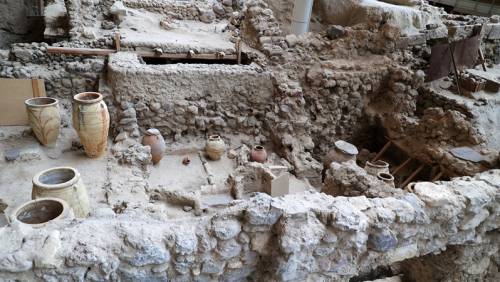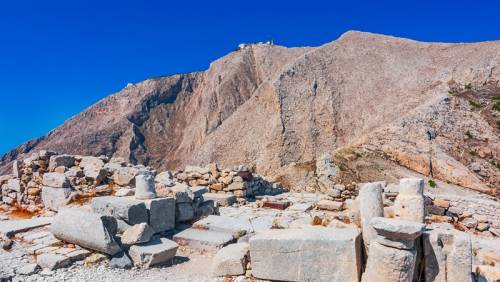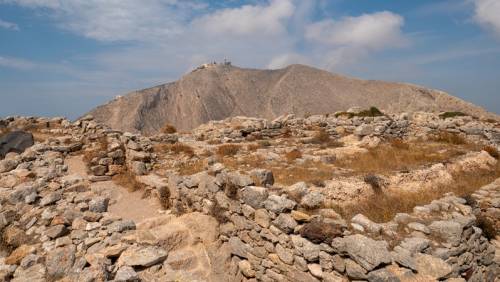
Now it’s time to explore the most iconic buildings of this Bronze Age city, frozen in time.
I suggest starting your visit at Building Beta — pause now and resume when you arrive there.
Here, archaeologists discovered some of Akrotiri’s most famous frescoes: the “Boxing Children”, depicting two young boys caught in a moment of play and training; the elegant antelopes, lush plants, and the enigmatic “Blue Monkeys” mentioned in the previous section.
Although many of the originals are now displayed in the museums of Fira and Athens, these rooms still tell the story of the painters’ extraordinary skill and of a world deeply connected to the Aegean and beyond.
Pause again and resume when you reach Building Delta.
This is where the celebrated “Spring Fresco” was found — a vibrant landscape of lilies and swallows dancing among pink rocks.
Even without the original painting, imagine the effect of those painted walls: the room itself became a garden, an immersive space designed to astonish visitors — and perhaps to evoke rituals celebrating the return of life after winter.
Pause and resume when you reach the House of the Ladies.
This building takes its name from the frescoes depicting graceful female figures that once adorned its walls, framed by motifs of papyrus and aquatic plants hinting at connections with distant lands, possibly Egypt. The women are portrayed wearing elaborate garments and intricate hairstyles.
Most of the original frescoes from the House of the Ladies are now displayed in the Museum of Prehistoric Thera in Fira, while some panels are housed at the National Archaeological Museum of Athens.
The building itself was an elegant residence, with formal reception rooms on the upper floors and work or storage areas on the ground level — a balance between beauty and practicality that reveals the high social status of its owners.
Pause and resume when you reach the West House.
Inside, in Room 5, archaeologists uncovered a miniature frieze — also preserved in the Museum of Prehistoric Thera — that unfolds like an ancient film strip. The sequence depicts a naval procession, a gathering on a hill, and even the dramatic scene of a shipwreck.
To complete your visit, I suggest ending your tour by admiring the many original frescoes on display at the Museum of Prehistoric Thera in Fira.
Let me leave you with an interesting fact: the frescoes of Akrotiri are so remarkably well preserved thanks to the volcanic ash that buried them for millennia. This natural seal protected their vivid pigments, allowing archaeologists to uncover the vibrant colors and intricate details of a civilization that vanished thousands of years ago.
1 hour of use
Unlock Artificial Intelligence (AI) and enhance your experience
Do you want to explore even more or discover cities not yet covered by the app?
Activate our AI.
It will guide you with the same engaging tone, answering your curiosities in real-time.