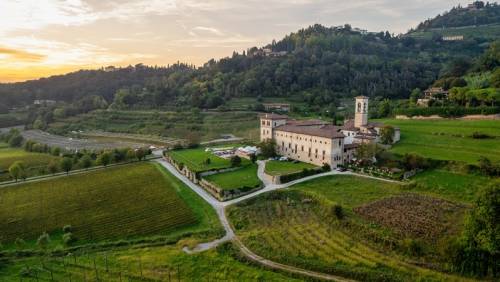
When, in 2021, Alessandro Allori’s Last Supper was relocated to the refectory of the former Astino monastery — the very space it was painted for in 1582 — the work finally returned to its original function as an “image-bridge” between the monks’ meal and the word of God.
The painting had been commissioned specifically for this room in 1580 by Abbot Don Calisto Solari, and it arrived from Florence in 1583.
As I mentioned earlier, the subject of the Last Supper was no coincidence: in the refectory, the monks ate in silence while a reader recited passages from sacred texts, and the large canvas transformed the daily meal into a visual reminder of the Gospel banquet and the communal meaning of shared food.
The composition draws attention to the central trio — Jesus, John, and Judas — at the precise moment when Christ identifies the one who will betray him.
Allori, a leading figure of late-Mannerist Florentine painting, adds a personal touch to the background with a wooden wall that enhances the brightness of the garments, and especially by emphasizing the “table” as a symbolic still life: unleavened bread and broken loaves, wine, and tableware become theological signs of the Eucharistic sacrifice and of the Jewish Passover, turning the painting into a lesson in catechism as well as a pictorial masterpiece.
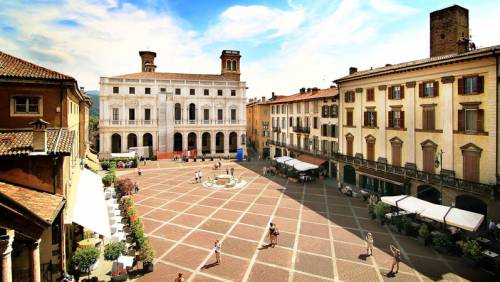
The painting’s conservation history tells a story of suppression and rediscovery. At the end of the 18th century, when the monastery was closed by Napoleonic decree, the painting was removed from the refectory and moved to other locations in the city. In the 19th century, the canvas was taken to the Palazzo della Ragione in the Upper Town, where it remained for a long time, darkened and largely overlooked.
Between 2012 and 2013, a revealing restoration was carried out, removing overpainting and deposits and bringing the original colors back to light. The next step was to return the painting to its refectory in Astino.
An interesting fact: in 1582, Allori created two versions of the same Cenacolo: one for Astino and another, in fresco, for the smaller refectory of the Carmine monastery in Florence. Comparing them is fascinating — they are almost identical, but in the Florentine “twin”, two small panels at the bottom on opposite sides depict the painter on the right and the patron on the left.
1 hour of use
Unlock Artificial Intelligence (AI) and enhance your experience
Do you want to explore even more or discover cities not yet covered by the app?
Activate our AI.
It will guide you with the same engaging tone, answering your curiosities in real-time.