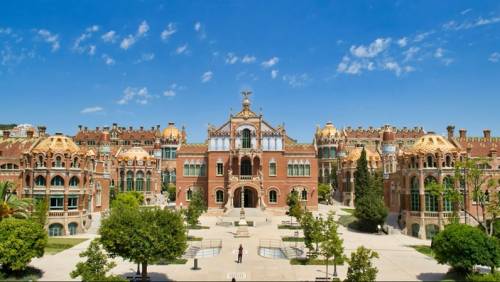
From the terrace of the Administration Pavilion — or even just from the entrance staircase — you immediately notice the harmony of the elegant pavilions, well-ordered gardens, and tree-lined avenues arranged with geometric precision.
The original complex included twelve main pavilions dedicated to patients, along with additional service buildings.
Each pavilion was independent, with its own entrances, utilities, and large windows designed to encourage natural ventilation.
This layout followed a clear medical principle: separate patients according to their illness to prevent the spread of infection.
The pavilions were arranged symmetrically along the central axis of the complex.
Below ground stretched a network of over one kilometer of underground tunnels connecting all the pavilions.
These tunnels allowed medical staff to move quickly and safely — even in bad weather — transporting patients, medicines, and equipment without interrupting their work.
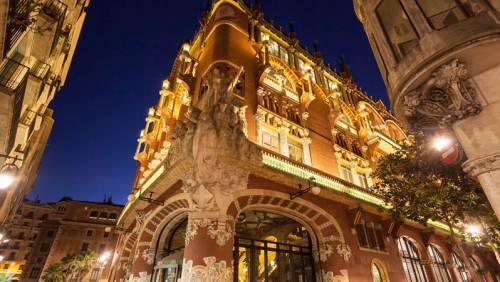
Every pavilion was decorated with colorful mosaics, stained glass windows, and glazed ceramics, each with a specific meaning.
Floral and geometric patterns symbolized renewal and healing, while the images of saints represented virtues such as hope and compassion.
Domènech believed that art could contribute to the psychological well-being of patients: in an age when medicine had few effective treatments, beauty itself became a form of therapy.
Even the gardens, arranged around each building, were designed as therapeutic spaces.
Throughout the 20th century, the pavilions were progressively adapted to new healthcare needs, while retaining their original identity.
Many of them can be visited today and host permanent exhibitions dedicated to the history of medicine, science, and Modernisme architecture.
Others have been transformed into the headquarters of international institutions such as Casa Asia and the World Health Organization, continuing the site's universal and humanitarian mission.
An interesting fact: One of the most impressive rooms is located in the Sant Rafael Pavilion, now restored and open to visitors.
Its large southeast-facing windows were designed to make maximum use of natural light during surgical procedures — an astonishing innovation for the time.
In the early 1900s, when artificial lighting was still limited, Domènech i Montaner had already understood that light could become a true ally of medicine.
1 hour of use
Unlock Artificial Intelligence (AI) and enhance your experience
Do you want to explore even more or discover cities not yet covered by the app?
Activate our AI.
It will guide you with the same engaging tone, answering your curiosities in real-time.