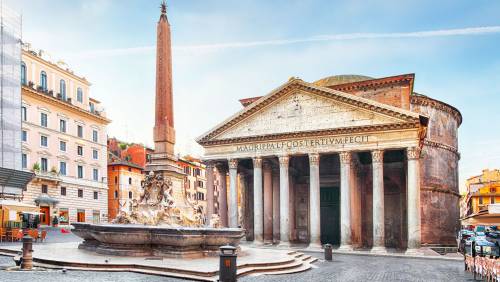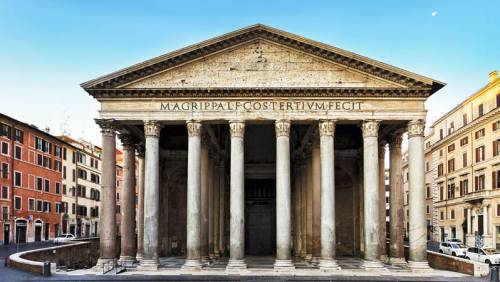
The exterior of the Pantheon combines monumental power with refined geometric precision. The front is dominated by the portico with its colonnaded façade: eight massive grey granite columns stand in the front row, with another eight arranged behind them. Each column is about 12 meters (nearly 40 feet) tall and topped with white marble Corinthian capitals. The portico acts as a transitional space between the urban square outside and the circular interior of the temple.
As mentioned earlier, an inscription runs along the entablature above the columns. It reads: “Marcus Agrippa, son of Lucius, consul for the third time, built this.” Although the current structure dates back to Emperor Hadrian in the 2nd century AD, the inscription honors Agrippa’s original construction from the Augustan period, preserving the memory of its first patron.
Behind the portico lies the pronaos, a covered area that serves as a grand entrance leading into the rotunda. It is here that the Pantheon breaks with the traditional Greco-Roman temple design: from an exterior rectangular form with columns and pediment, one enters a completely circular interior crowned by a dome. This architectural transition was revolutionary for its time.
The Pantheon was built using a combination of materials: travertine for foundations and major structural elements, bricks and Roman concrete for the walls, and granite and marble for decorative parts. Roman concrete, made from lime and volcanic ash (pozzolana), was essential for achieving the building’s durability and impressive scale.
The building’s proportions are based on perfect geometric harmony. The diameter of the rotunda is about 43.3 meters (142 feet), which is exactly equal to the height from the floor to the top of the dome—creating an interior space that could fit inside a perfect sphere. Many scholars interpret this design as a symbol of the union between earth and sky.
The exterior of the dome is less refined than the interior. It is covered with lead sheets and built in a stepped formation to reduce weight and increase stability. The structure becomes progressively lighter toward the top: heavy stones at the base, tuff stone in the midsection, and pumice in the uppermost layers. Likewise, the thickness of the dome decreases from about 6 meters (20 feet) at the base to just over 1 meter (3 feet) near the oculus.
The rotunda walls are constructed with concentric rings that include niches and relieving arches to distribute the weight of the dome. This engineering technique allowed the Romans to achieve architectural dimensions never before seen in the ancient world.
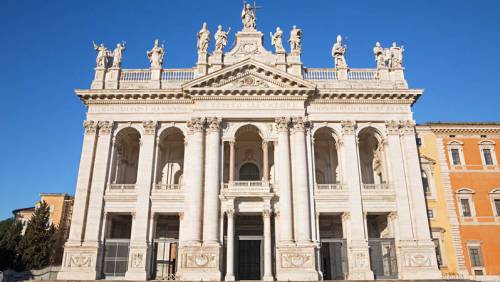
An interesting fact: In the 17th century, some of the side columns of the portico were removed by order of Pope Urban VIII and later Pope Alexander VII, to be reused in the Basilica of St. John Lateran. Replacement columns were added, but they were of different quality and materials. While the building’s stability was not affected, the symmetry and harmony of the portico were partially altered.
1 hour of use
Unlock Artificial Intelligence (AI) and enhance your experience
Do you want to explore even more or discover cities not yet covered by the app?
Activate our AI.
It will guide you with the same engaging tone, answering your curiosities in real-time.