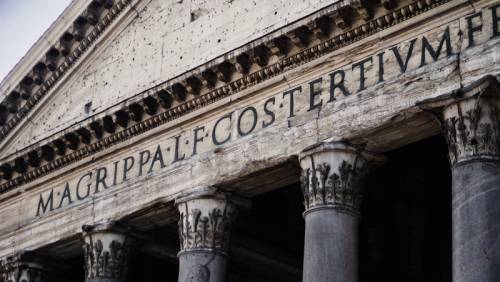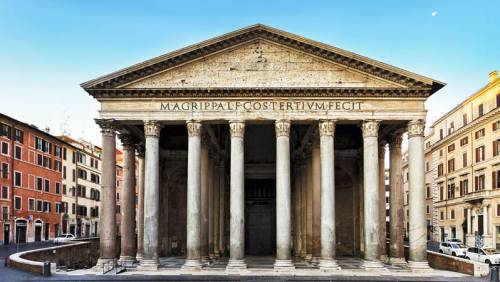
The Pantheon was originally built during the age of Augustus, commissioned by Marcus Vipsanius Agrippa, the emperor’s son-in-law and trusted advisor. The first structure, completed in 27 BC, was dedicated to all the gods—hence the name Pantheon, from the Greek pan (all) and theon (divine). A trace of that first building still remains today in the inscription on the front of the portico, which translates as: “Marcus Agrippa, son of Lucius, consul for the third time, built this.”
Unfortunately, Agrippa’s Pantheon was damaged by fires and had to be rebuilt at least twice. The building we see today is mainly the work of Emperor Hadrian and was constructed between 118 and 125 AD. Hadrian, in an act of respect, chose not to engrave his own name on the temple and instead preserved Agrippa’s original dedication. However, he completely redesigned the structure as a circular temple with a massive hemispherical dome and a columned portico in front.
Centuries later, in 609 AD, the Pantheon underwent a turning point. The Byzantine emperor Phocas donated it to Pope Boniface IV, who consecrated it as a Christian church under the name Santa Maria ad Martyres. This transformation protected the building from being destroyed or stripped of its materials, a fate that befell many other ancient temples.
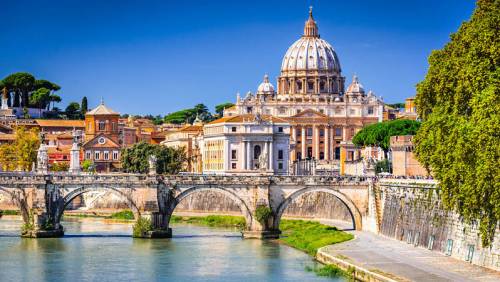
During the Middle Ages and the Renaissance, the Pantheon remained an active place of worship and became a prestigious burial site. Several notable figures were laid to rest here, including the artist Raphael. From the 19th century onward, it also became the burial place of the Italian kings Vittorio Emanuele II and Umberto I. Over time, certain modifications altered its original appearance—for example, in 1625, Pope Urban VIII ordered the removal of the bronze roof tiles from the portico, which were later used to create the baldachin in St. Peter’s Basilica.
Because of its remarkable design, the Pantheon became a subject of study for architects of the modern era, including Brunelleschi and Michelangelo, who admired its perfect proportions. In the 19th century, after the unification of Italy, it became a symbol of national identity.
Today, the Pantheon is not only a historical monument but also an active Catholic basilica.
An interesting fact: After studying the Pantheon, Michelangelo is said to have declared that it was built “not by men, but by angels.” Whether symbolic or literal, this famous remark is often quoted to express the extraordinary nature of its architecture and proportions.
1 hour of use
Unlock Artificial Intelligence (AI) and enhance your experience
Do you want to explore even more or discover cities not yet covered by the app?
Activate our AI.
It will guide you with the same engaging tone, answering your curiosities in real-time.