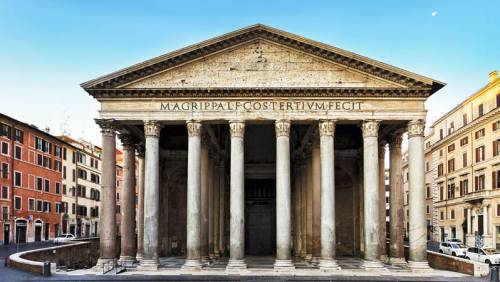
As you step inside the Pantheon, you enter a space that immediately captivates you with its perfect proportions and sense of harmony.
The entrance is marked by a massive bronze door, about 7 meters (23 feet) high. Although it is not the original door from Agrippa’s time, it still dates back to antiquity, likely to the 4th century. Once you pass through it, the space opens suddenly and dramatically, emphasizing the seamless transition from the portico into the circular hall.
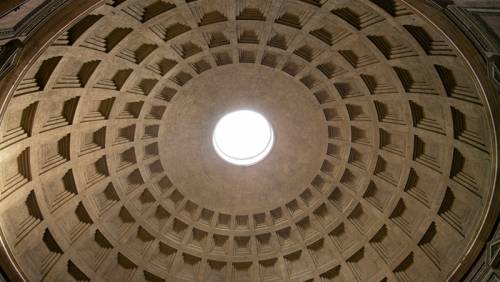
The most extraordinary element is the dome — one of the largest ever built in masonry. It is hemispherical and rests on a cylindrical drum. At its center lies the oculus, a circular opening measuring 8.3 meters (27 feet) in diameter. This is the only source of direct natural light inside the Pantheon, and it has no glass covering. When it rains, the water falls through the oculus and is drained through small holes in the floor. Symbolically, the oculus has often been interpreted as a link between the temple and the heavens, between the human and the divine.
The interior of the dome is adorned with five concentric rows of coffers—recessed geometric panels—which reduce the weight of the structure while enhancing its visual depth. Originally, these coffers were decorated with gilded bronze or stucco.
The floor you are standing on is original, dating back to the time of Emperor Hadrian. It is made of marble and porphyry arranged in perfectly aligned geometric patterns: circles, squares, and rectangles in colors like ancient yellow marble, deep red porphyry, and gray-veined “pavonazzetto” marble. The center of the floor is entirely level, but it gently slopes toward the edges to allow rainwater from the oculus to flow into a drainage system.
The walls are articulated by columns and niches, creating a rhythmic architectural pattern of solids and voids. These niches once held statues of Roman gods, which were later replaced by Christian altars and religious artworks after the church’s consecration.
An interesting fact: The interior of the Pantheon is based on a precise geometric concept: the diameter of the rotunda is equal to its height up to the center of the dome—about 43 meters (142 feet). This means the entire space can be inscribed within a perfect sphere. This perfect symmetry was not just aesthetically pleasing—it also demonstrates the Romans’ advanced understanding of mathematics and engineering.
1 hour of use
Unlock Artificial Intelligence (AI) and enhance your experience
Do you want to explore even more or discover cities not yet covered by the app?
Activate our AI.
It will guide you with the same engaging tone, answering your curiosities in real-time.