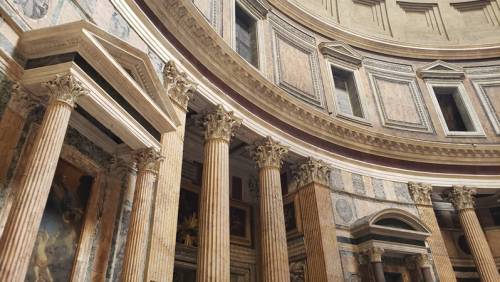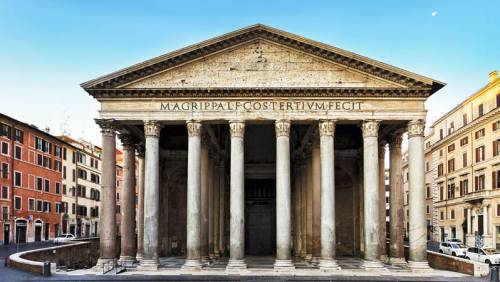
The interior of the Pantheon follows a radial design. Along the circular wall, seven main niches open symmetrically, separated by marble columns and massive pillars. In ancient Roman times, these niches held statues of gods, but after the Pantheon was consecrated as a Christian church in 609 AD, they were transformed into chapels and altars.
To follow the traditional clockwise route, once you enter and stand with your back to the main door, turn to your right. The first chapel you encounter is the Chapel of Saint Joseph, followed by the Chapel of the Pietà, which houses an ancient Marian icon attributed to the Byzantine tradition. Next is the High Altar, adorned with a Baroque baldachin and an altarpiece depicting the Coronation of the Virgin, painted by Melozzo da Forlì. One of the most significant chapels is the Chapel of the Crucifix, where fragments of ancient Roman decorations are still visible.
The Pantheon is also a burial place, and its most famous tomb is that of Raphael, who died in 1520 at the age of 37. Since 1833, a fresh bouquet of flowers has been placed at his tomb every day, a tradition upheld by the Academy of Saint Luke. In the adjacent chapel lies his fiancée, Maria Bibbiena, who died just a few months after him at about 31 years old. Other notable figures buried here include the painter Annibale Carracci and the composer Arcangelo Corelli.
From the 19th century onward, the Pantheon became the mausoleum of the Italian monarchy. The tombs of King Victor Emmanuel II and King Umberto I, along with Queen Margherita of Savoy, are located here. These royal tombs are recognizable by the coat of arms of the House of Savoy and their solemn yet understated decoration.
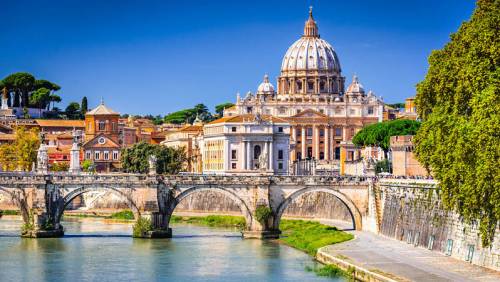
The interior decoration combines ancient Roman materials with Renaissance and Baroque interventions. The walls are covered in polychrome marble, and most of the columns are in the Corinthian style. The ceiling of the pronaos (the entrance hall) was originally adorned with bronze coffers, but in the 17th century, they were removed and melted down—to be used, among other things, for the baldachin in St. Peter’s Basilica.
As you can see, with its conversion into a Christian church, new elements such as crosses, altars, candlesticks, and sacred images were added, but the original Roman architectural structure was left untouched. The ancient harmony of the space was preserved while being adapted to a new faith.
An interesting fact: Raphael died on April 6, 1520, which was also his 37th birthday, after a sudden illness. His marriage to Maria Bibbiena had been arranged for reasons of social prestige and supported by the Pope, yet Raphael postponed the wedding several times—partly because he was emotionally involved with another woman, while Maria was already seriously ill. Despite this, the two now rest side by side in the Pantheon and have done so for over five hundred years.
1 hour of use
Unlock Artificial Intelligence (AI) and enhance your experience
Do you want to explore even more or discover cities not yet covered by the app?
Activate our AI.
It will guide you with the same engaging tone, answering your curiosities in real-time.