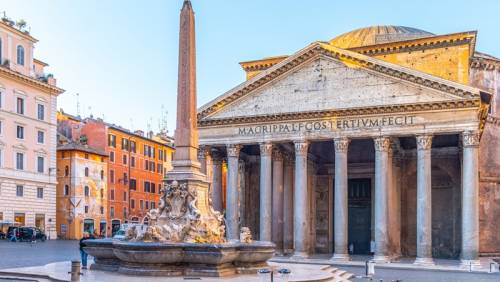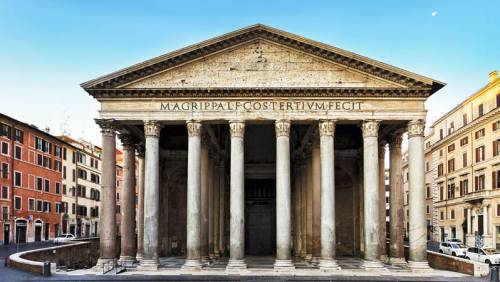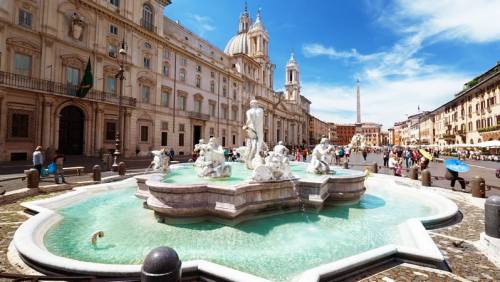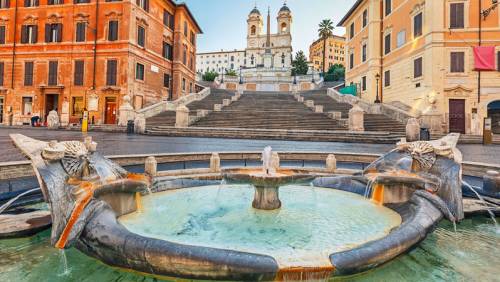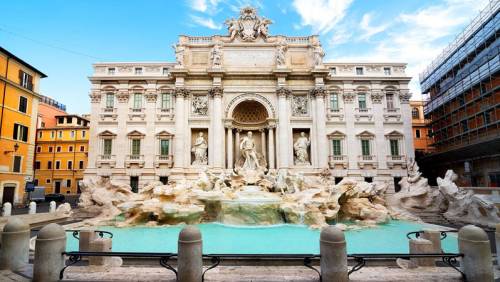
The square in front of the Pantheon is called Piazza della Rotonda. This name has been used since the Middle Ages, when the Pantheon was commonly referred to as “Santa Maria della Rotonda.”
In ancient times, this area was part of the Campus Martius, a district dedicated to public buildings and imperial monuments. The square’s current layout mostly dates back to the 16th and 17th centuries, when Pope Gregory XIII and other popes promoted renovations to give the space in front of the Pantheon a more dignified appearance.
At the center of the square stands a Renaissance fountain, designed in 1575 by Giacomo Della Porta and sculpted by Leonardo Sormani under Pope Gregory XIII. The fountain has an octagonal base, is surrounded by steps, and originally served as both a decorative feature and a source of water for local residents.
In 1711, Pope Clement XI commissioned the architect Filippo Barigioni to modify the fountain and place an Egyptian obelisk on top of it.
This obelisk, known as the Obelisco Macuteo, comes from the Temple of the god Ra in Heliopolis, Egypt. It is about six meters tall—nearly fourteen meters including its base—and made of red granite. By the way, did you know that the word “obelisk” comes from Greek and means “skewer” because of its tall, pointed shape? This ancient object was reused during the Roman Empire and finally placed here in the 18th century.
Over the centuries, houses and palaces were built around the square. Many medieval buildings were replaced by Renaissance structures featuring shops on the ground floor, a clear sign of the area’s longstanding commercial role. Until the 19th century, the square hosted markets, vendor stalls, and even butcher shops. In 1847, Pope Pius IX had to ban activities considered too noisy or inappropriate given the Pantheon’s proximity.
The irregular alignment of the buildings and the slightly trapezoidal shape of the square reveal how the urban layout evolved organically. This space was not planned all at once; it gradually developed around the Pantheon, adapting to residential and commercial needs through the centuries.
An interesting fact: In the Middle Ages, this square hosted a fish market. The fountain’s water was used to wash the fish before selling it, which is why the locals used to call it “Piazza della Rotonda dei pesci” – the fish market square of the Pantheon.
1 hour of use
Unlock Artificial Intelligence (AI) and enhance your experience
Do you want to explore even more or discover cities not yet covered by the app?
Activate our AI.
It will guide you with the same engaging tone, answering your curiosities in real-time.